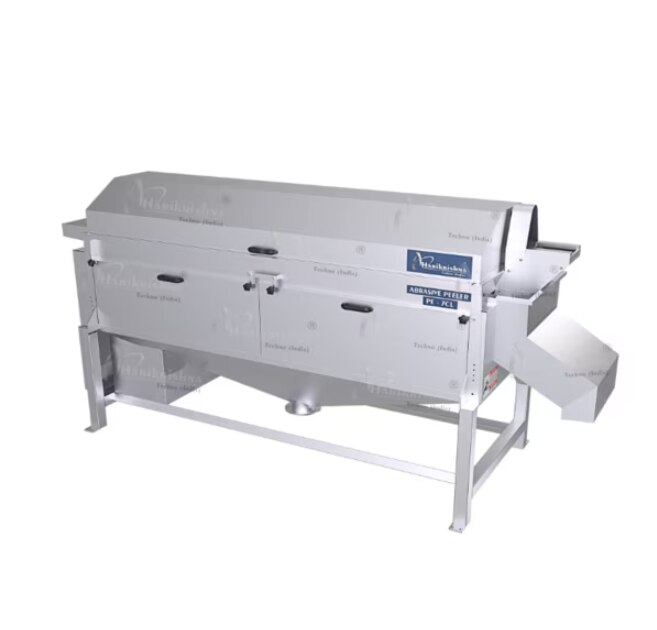
A PE7CL model code does not tell you whether the quotation includes the abrasive chamber, controls, water hardware, spares or commissioning, and it does not establish the machine’s real throughput. By the end, you will have a checklist for the supplied package, the specification sheet and a product trial that tests yield, skin removal and line capacity.
Key takeaways
- Request a line-by-line list of every machine, control, spare and installation item.
- Obtain PE7CL capacity, power, dimensions, abrasive and safety specifications in writing.
- Match drum size and feed rate to your crop, batch size and shift routine.
- Witness a crop trial and record yield, peel loss, throughput and cleaning time.
Check every component listed in the PE7CL supply package
A quote is incomplete if it calls the package “complete” without itemizing it. To establish what is included with a PE7CL abrasive peeler, require a line-by-line scope: a standalone machine is not the same as a ready-to-run potato or onion preparation line.
Confirm that the quoted PE7CL includes:
- Abrasive chamber, lining or discs, feed hopper, product outlet and discharge chute
- Water inlet, spray bar, drain connection and drain outlet
- Motor, gearbox, frame or legs, covers, guards and emergency stop
- Starter or control panel, internal wiring, operating instructions, tools and export packing
| Item | Include in the base price only when stated | Confirm as optional or excluded |
|---|---|---|
| Water and drainage | Valve, spray arrangement and drain connection are named | Water-control valve, drain hose or filtration |
| Spares and handling | Trolley and commissioning materials are listed | Spare abrasive lining, bearings or stainless-steel trolley |
| Site delivery | Installation and commissioning scope is defined | Installation, training, freight and electrical plug |
| Line equipment | Inlet and outlet interfaces are specified | Conveyor, washer, elevator, inspection table or cutter |
For a commercial abrasive peeling machine, inspect whether the abrasive parts are removable, the shaft seal and outlet have no peel traps, and the drain resists choking. Do not assume high-pressure washing is permitted unless the enclosure, motor and controls are rated for it.
Demand a complete PE7CL specification sheet, not a model-code promise
A PE7CL model code does not tell you enough to compare quotations. Ask for a dated specification sheet or nameplate record showing the machine’s chamber capacity, rated throughput and intended crop, because model codes are not standardised between manufacturers.
Require these figures in writing:
- Capacity in kg per batch and kg per hour, with the crop, size range and loading quantity used for the rating
- Peeling yield, peel-loss percentage, cycle time and stated water consumption in litres per hour or per cycle
- Motor power in kW or hp, voltage, phase, frequency, full-load current and starter or control-panel type
- Overall length, width and height, service clearance, net weight and required floor area
- Water-inlet size, operating pressure, drain size and spray arrangement
- Abrasive lining or disc material, replaceable-part dimensions and expected wear limits
- Product-contact material by component, including steel grade for the chamber, shaft, fasteners, outlet, welds and water-contact parts
Use the PE7CL abrasive peeler specifications to make suppliers quote the same basis:
| Field | Demand in the offer | Cost or performance risk |
|---|---|---|
| Throughput | kg/h for your crop and size | An optimistic rating makes capacity comparisons useless |
| Water use | Litres per batch or hour | A low purchase price can create higher operating and treatment costs |
| Electrical supply | kW, voltage, phase and frequency | Incorrect data can require rewiring or a transformer |
| Construction | Grade and abrasive-surface material | Unidentified contact parts complicate hygiene and replacement |
| Scope | Standalone machine or ready-to-run line | Conveyors, filtration and commissioning may be excluded |
Match the peeler to your crop, batch and operating routine
A 7 kg chamber does not mean 7 kg per minute. Peeling results change with onion diameter, variety, firmness, moisture, skin adhesion and loading depth; mixed sizes leave small onions over-peeled while large ones retain skin. Confirm the product range and define capacity as finished kilograms per hour, not only batch size.
1. Pre-sort and weigh the onions, removing rotten, split or unusually soft bulbs. Pre-wash loose soil without soaking the crop, because excess surface water changes abrasive action and increases wastewater solids.
2. Load the stated batch weight, never a full chamber by guesswork. Record the peeling cycle, water volume and discharge time; overloading reduces contact with the abrasive surface and leaves skin behind.
3. Inspect the discharged onions for residual skin, flesh loss and bruising. Weigh usable product and peel waste separately, then calculate yield from the same crop and batch size you will run in production.
4. Clean the chamber, spray bar, drain and abrasive surface after the run. Check the lining or disc for blocked areas, uneven wear and trapped peel before the next batch.
Ask what is included with a pe7cl abrasive peeler before assuming the line is ready: abrasive chamber, inlet, discharge, motor, controls, spray arrangement, drain connection, guards, frame and cleaning tools may be separate. Record abrasive onion peeler details alongside your own trial results.
Longer cycles remove stubborn skin but increase flesh loss, so approve the machine against your acceptable yield, not a peeling percentage without test conditions.
Compare abrasive, blade and brush systems by yield and upkeep
Choose an abrasive system when you need high throughput across potatoes or firm root vegetables and accept a measured flesh loss for simpler, continuous skin removal. Blade systems can preserve more yield on uniform products but demand sharp blades, accurate adjustment and frequent sanitation.
Brush systems are gentler, yet they may leave stubborn skin and require close brush inspection.
| Option | Yield trade-off | Upkeep |
|---|---|---|
| Abrasive | Fast removal; excessive residence time increases flesh loss, bruising and wastewater solids | Replaceable abrasive lining or discs, clear drain, inspectable shaft seal and peel-free chamber |
| Blade | Potentially lower peel loss on consistent shapes; dull or misaligned blades cause tearing and unpeeled patches | Sharpening or replacement, blade adjustment and strict guarding |
| Brush | Lower impact on delicate surfaces; residual skin can reduce usable yield | Brush wear checks, cleaning between batches and replacement when bristles flatten |
For a commercial abrasive peeling machine, inspect these points before approval:
- Remove or inspect the abrasive surface, chamber, outlet and spray bar without creating peel traps. Price the lining as a spare.
- Confirm the product-contact grade for the chamber, fasteners, shaft, welds and water parts; “stainless steel body” is not enough.
- Ask for litres per batch or hour, drain capacity and wastewater-solids handling. Do not assume high-pressure washing suits the motor, enclosure or controls.
- Run intended onions separately: define residual skin, breakage, bruising and peel loss. The abrasive onion peeler details should state the variety, load, cycle time and loss measurement.
Use a witnessed trial to approve the quotation and supplier
Run the machine with your intended onion, potato or carrot variety before you accept the quotation. A nameplate batch figure does not prove finished throughput: record loading weight, cycle time, hourly output, peel loss, residual skin, split bulbs, bruising and rejected product under an agreed tolerance.
1. Witness at least three consecutive cycles using your prepared product. Weigh the input, saleable output, removed peel and damaged pieces separately; calculate peel loss as a percentage of input, not as the supplier’s estimate.
2. Match the trial record against the PE7CL abrasive peeler specifications. Confirm whether the quoted capacity means batch loading or kilograms per hour, then record motor power, voltage, phase, frequency, water consumption, dimensions, weight and required floor space.
3. Inspect the machine while it is empty and running. Put the abrasive chamber or lining, shaft, fasteners, welds, outlet and water-contact parts on the material declaration, including the stainless-steel grade; ask for serial-numbered drawings and electrical documentation.
4. Read the packing list aloud before signing approval. It must identify the hopper, abrasive surface, motor, gearbox, frame, covers, control panel, emergency stop, wiring, spray bar, water inlet, drain, tools and commissioning materials. List conveyors, washer, elevator, filtration and downstream equipment as separate items if excluded.
If comparing HARIKRISHNA TECHNO (INDIA) with another PE7CL peeler manufacturer in Rajkot, use the same signed trial sheet, warranty boundaries, spare-parts response time and crop-specific customer references for both quotations. Reject any offer that changes the tested machine or scope afterward.
Related product
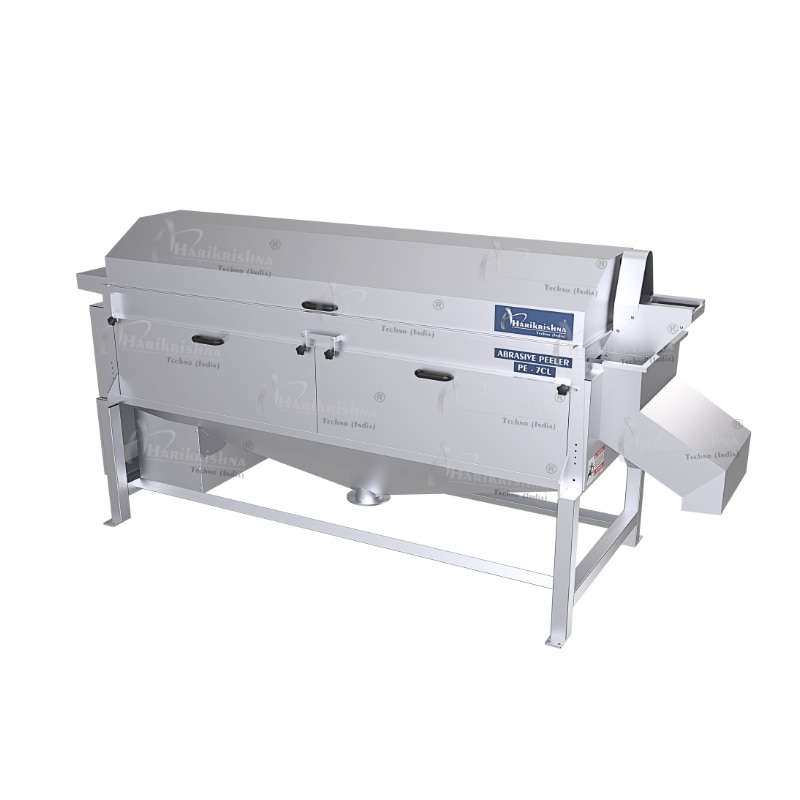 | PEELER Abrasive Peeler Model PE7CL used to remove the outer skin of fruits and vegetables through friction. View product → |
Frequently asked questions
What is included with a PE7CL abrasive peeler?
Ask the supplier to itemize the peeler, motor, controls, guards, feed and discharge arrangements, abrasive parts, spares, documentation, installation scope and commissioning. Do not accept “complete package” without a line-by-line list.
Which PE7CL abrasive peeler specifications should you request?
Request rated capacity, batch size, drum dimensions, motor power, electrical requirements, machine dimensions, construction material, abrasive type, feed and discharge details, water requirements, safety features, cleaning method and included spares.
How do you match a PE7CL peeler to potatoes or onions?
Compare the machine with your crop size, skin condition, batch weight, target throughput, available floor space, labour routine and cleaning process. Confirm performance through a witnessed trial using your own crop.
How should you compare abrasive, blade and brush peeling systems?
Measure saleable yield, peel loss, product damage, throughput, abrasive or blade replacement, brush wear, water use, cleaning time and maintenance access. Choose the system that meets your product specification at an acceptable upkeep cost.
What should a witnessed PE7CL trial record?
Record crop variety and size, starting weight, batch time, finished weight, peel waste, damaged pieces, water use, operator count, cleaning time and any machine stoppages. Use the results to approve or revise the quotation.
Keywords