A slicer is worthwhile only when your raw-material supply, labour, production schedule and frying or drying capacity can absorb its output. Use the decision tests below to determine whether your Rajkot business needs automated slicing, what specifications to demand, and when a smaller or semi-automatic setup makes more sense.
Key takeaways
- Choose a slicer when repeatable volumes feed frying or drying lines.
- Match hourly capacity to peak demand, not your average daily output.
- Test slice thickness, raw-material size and frying results before buying.
- Require guards, cleanable food-contact parts and documented sanitation controls.
Which Rajkot businesses have a strong use case for a banana cassava slicer?
Banana-chip units, cassava-chip producers, farsan shops, central kitchens, caterers and contract snack manufacturers have a strong use case when they process repeatable commercial volumes and feed sliced produce into frying or drying. The right banana cassava slicer for food businesses in Rajkot supports a controlled production line; it does not replace one.
| Buyer type | Strong use case | Better choice |
|---|---|---|
| Banana-chip unit | Green, firm bananas and standardized fried output | Semi-automatic for small batches; automatic for steady volume |
| Cassava-chip producer | Fresh roots with defined peeling, cutting, soaking, fermentation, drying, cooking or frying | Automation only when roots can be processed quickly |
| Farsan shop or caterer | Repeatable batches with enough fryer or dryer capacity | Semi-automatic when labour or fryer capacity limits output |
| Central kitchen or contract manufacturer | Continuous supply of uniform fried or dried snacks | Automatic when hand slicing delays batches or creates accumulation |
Use banana chips processing equipment with green, firm bananas, not ripe dessert bananas. Ripe fruit deforms, sticks and darkens more readily. Cassava slicing alone does not make the product safe; cyanogenic glycosides require a validated downstream process.
Before buying, record:
- Kilograms of raw banana or cassava per day
- Peak production hours, batch sizes and available operators
- Hand-slicing wages, rework and inconsistent slices
- Fryer or dryer capacity and acceptable holding time
Choose semi-automatic equipment for seasonal production or limited supply. Choose automation when hand labour is the bottleneck and the downstream line can consume slices without delay. Intermittent retail slicing is a weaker case than standardized snack production.
How do you match machine capacity to your actual production?
Specify three capacities before comparing machines. A nameplate figure is not finished-product capacity.
| Measure | Record separately | Why it matters |
|---|---|---|
| Raw-material feed | Kilograms per hour | Shows how much banana or cassava enters the machine |
| Cutting speed | Pieces per minute | Shows blade and feeding performance |
| Saleable output | Kilograms per hour after rejects and breakage | Shows what can actually reach frying or drying |
Slice thickness, banana or cassava diameter, loading method, operator speed, trimming losses and rejected pieces change the usable result. Ask the supplier to trial your own raw material and record input weight, output weight, reject weight, operating minutes, cleaning interruptions and batch changeover time.
Compare saleable output with your peak-hour requirement, not average daily volume. A fast banana cassava slicing machine can create a pile of cut produce when the fryer, dryer, dewatering unit or seasoning line runs slower.
Fresh cassava deteriorates rapidly after harvest, so a high hourly rate is a poor advantage if your team cannot peel and process roots quickly.
For banana chips processing equipment, calculate hand-slicing cost from wages, output per operator, rework, inconsistent slices and injury-related downtime. Choose the smallest machine that meets required saleable output with operating margin. Paying for speed your downstream process cannot absorb adds accumulation, waste and cleaning time rather than capacity.
What raw-material and slice specifications should you test?
Put a numerical target in millimetres for slice thickness, its allowable variation, maximum piece size, feed dimensions and acceptable breakage. Do not accept “uniform slicing” as a specification.
| Raw material | Trial requirement | Main risk |
|---|---|---|
| Green banana | Record cultivar, maturity stage, target thickness and tolerance | Ripe fruit deforms, sticks, darkens and fries poorly |
| Cassava | Record root diameter, fibre condition, irregular ends and trimming loss | Dense, fibrous roots increase breakage |
Evaluate a commercial banana slicer in Rajkot with the cultivar and maturity stage you actually buy. Green bananas are firmer and less deformable; ripe bananas contain more soluble sugar. Cassava needs its own setting because diameter, fibre structure, surface damage and irregular ends change cutting force and breakage.
Ask the supplier:
- Can operators load whole produce, or must they trim ends and cut oversized pieces?
- What diameter or length does the feed opening accept?
- Does thickness change through calibrated control, spacers, blade clearance or feed-pressure adjustment?
- What maximum piece size and breakage percentage will the trial guarantee?
- Can the supplier measure repeatability across several batches?
Do not assume one adjustment suits both products. A shared cassava chips slicer and banana slicer needs separate documented blade geometry, feed pressure and trial settings. Inspect the slices through your fryer or dryer: thick pieces retain moisture and cook slowly, while thin or broken pieces over-brown.
Record feed input, saleable output and slice variation for each product rather than relying on one nameplate capacity.
What safety, sanitation and process controls must accompany slicing?
Slicing is one preparation step, not a complete chip-making or cassava-safety system. Banana and cassava production still require peeling, washing, dewatering, frying or drying, seasoning, cooling and packing. A banana cassava slicing machine cannot replace those controls.
1. Treat cassava detoxification as a separate validated process. Cassava contains cyanogenic glycosides, and slicing does not remove them. Define and verify the peeling, cutting, soaking, fermentation, drying and heating steps for your raw material and product. Do not rely on the machine specification or an untested time and temperature.
2. Request the food-contact steel grade and traceability, weld finish, gasket materials, lubricant controls and written cleaning instruction. Check for drainable product zones, removable blades, cleanable guards and tool-less access. Difficult-to-drain surfaces and inaccessible food traps turn a short cleaning job into a contamination risk.
3. Document disassembly, cleaning and inspection before changing between banana and cassava. Record blade removal, feed-part cleaning, gasket inspection and reassembly, then verify that no fibres, starch or damaged product remain.
4. Before comparing speed or price, verify the emergency stop, blade guarding, motor overload protection, electrical supply, safe access and spare-blade availability. A cassava chips slicer that cannot be safely serviced will not deliver reliable output across a full production shift.
How should a Rajkot buyer make the final machine decision?
1. Arrange a representative trial before approving any commercial banana slicer in rajkot. Use the banana cultivar and maturity you buy, the cassava diameter you process, your normal batch size and target slice thickness. Record feed input, saleable output, reject percentage, pieces per minute, slice-thickness variation, operator count, changeover time and cleaning access.
2. Run those slices through your actual fryer or dryer, not only onto a receiving tray. Uneven slices change oil residence time, final moisture, texture, colour and yield; thin or broken pieces can over-brown while thick pieces cook slowly. Repeat the test for banana and cassava because one setting does not prove performance for both.
3. Check the quoted machine against your electrical supply, then inspect blade guards, the emergency stop, motor overload response and access to replacement blades. Ask for the target thickness range, allowable variation and capacity stated as both feed input and saleable output.
This is the evidence a banana cassava slicer for food businesses in rajkot should provide.
4. Choose lower throughput when you run a small farsan shop, seasonal operation or modest central kitchen whose fryer cannot absorb continuous output. Choose larger capacity when a processor, contract manufacturer or dedicated snack factory can secure raw material, staff blade changes and cleaning, and sell steady volumes.
HARIKRISHNA TECHNO (INDIA) belongs in that comparison, but documented trials and operating fit should outweigh a generic high-capacity claim.
Related product
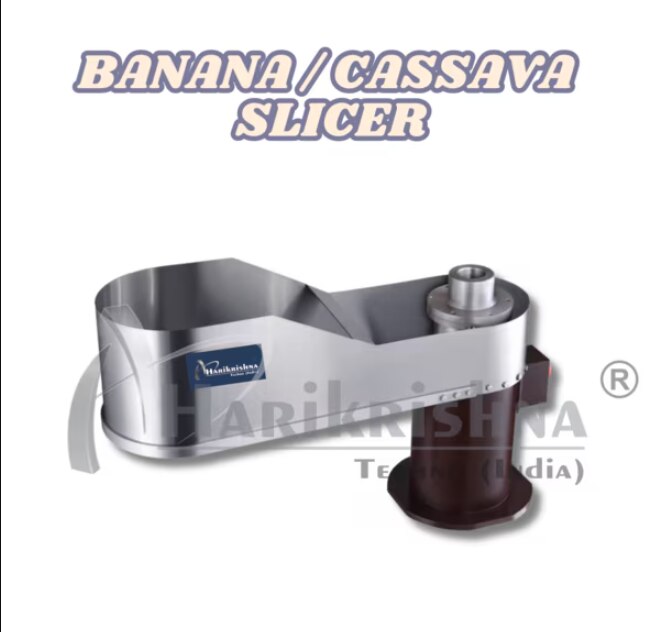
 | BANANA / CASSAVA SLICER This high-performance Banana/Cassava Slicer is a versatile and efficient solution for commercial food processing. View product → |
Frequently asked questions
Which Rajkot businesses should use a banana cassava slicer?
Banana-chip units, cassava-chip producers, farsan shops, central kitchens, caterers and contract snack manufacturers benefit when they process repeatable commercial volumes for frying or drying.
How should you match slicer capacity to production?
Calculate peak hourly demand, account for loading and cleaning time, and choose capacity that supports the complete frying or drying line without creating a raw-material bottleneck.
What should you test before buying a banana cassava slicer?
Test the actual banana and cassava varieties, maturity levels, diameters and moisture conditions. Measure slice thickness, breakage, yield and the finished product after frying or drying.
What safety and sanitation controls does a slicer need?
Specify guarded blades, emergency stopping, stable feeding and cleanable food-contact surfaces. Create procedures for isolation, dismantling, washing, sanitising, inspection and drying.
Keywords