An L-type kneader suits a restaurant only when its usable batch size, dough load, electrical supply and cleaning method match the kitchen’s real service pattern. By testing those factors against your menu and peak demand, you can decide whether to buy this machine, choose a spiral or planetary mixer, or keep a smaller manual setup.
Key takeaways
- Measure peak service demand instead of daily average dough use.
- Match bowl capacity and motor torque to your heaviest dough.
- Run a production trial before committing to the machine.
- Confirm installation, cleaning access and local service support.
Start with the restaurant’s actual dough demand
A dedicated L-type kneader makes sense when your Rajkot restaurant produces repeatable dough batches throughout the day, rather than occasional small quantities. Measure the peak service demand, not the daily average: a machine that handles breakfast preparation can still fail during lunch if consecutive batches exceed its continuous-duty limit.
Calculate the requirement as:
- Peak dough needed ÷ usable dough load = batches required
- Batches required × loading, kneading, unloading and cleaning time = production time
- Required production time compared with the available preparation window = capacity decision
Use actual flour and dough weights. A “25 kg” machine may refer to maximum dough under one recipe, not 25 kg of flour; a dense dough places different torque demands from high-hydration dough. Ask for the permitted flour load and test your recipe before ordering an l type flour kneading machine for restaurant in Rajkot.
Choose a restaurant flour kneading machine only if the kitchen has floor space for loading and unloading, the electrical supply matches the motor, and staff can clean the bowl and arm without unsafe dismantling. Check whether flour collects behind seals or under the rim, and whether the manufacturer permits washdown.
If you need whipping, emulsions, frequent tiny batches or rapid recipe changes, a planetary mixer may suit the workflow better.
What the L-type mechanism does—and which doughs it handles
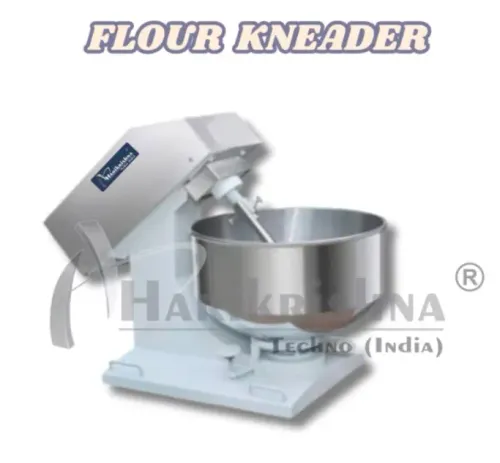
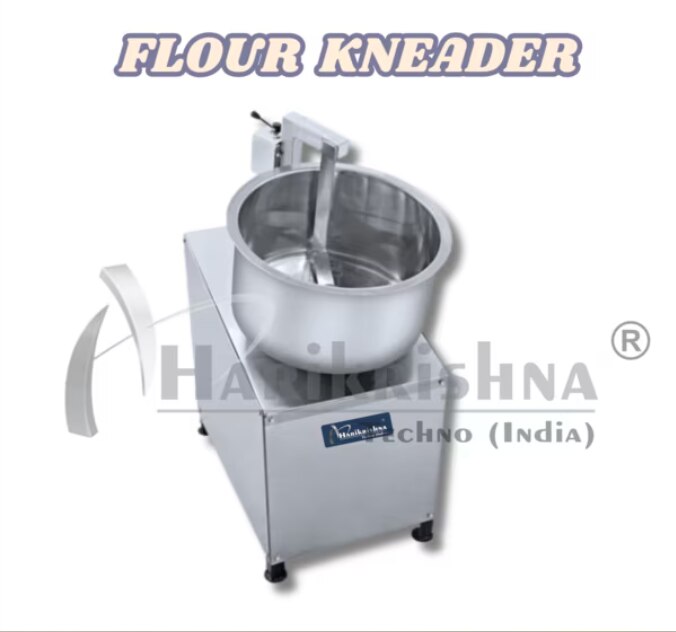
An L-shaped arm travels through a fixed bowl, folding and pressing dough against the wall before lifting it for another pass. This creates a dedicated kneading action for dense, homogeneous mixtures rather than whipping or emulsifying, making an l type dough kneader for restaurant kitchens with repeatable dough production.
| Machine | Mixing action | Best fit |
|---|---|---|
| L-type | Folding and pressing by an L-shaped arm | Chapati, naan, puri, paratha, pizza and snack dough |
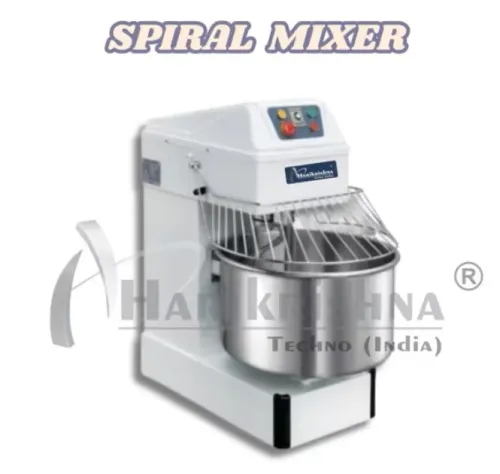
| Spiral | Rotating spiral hook and bowl develop gluten efficiently | High-hydration bread, pizza and large elastic dough batches |
| Planetary | Interchangeable tools rotate around a fixed bowl | Small batches, batters, creams, emulsions and varied recipes |
Choose the L-type design when consistent kneading matters more than attachments or rapid recipe changes. It handles wheat dough for chapati, naan, bread, puri, paratha and pizza, plus firm snack doughs and besan-based mixtures.
A planetary mixer is better for whipping and batters; a spiral mixer is usually better for high-volume bread production or dough needing stronger gluten development.
A kneading machine for food business must match peak demand, not the daily average. Check flour load and finished-dough weight separately, because 20 kg of flour and 20 kg of wet dough create different torque.
During a trial, record mixing time, dough temperature before and after mixing, overload events and dry flour left on the bowl wall. Friction can overheat yeast dough, forcing slower speeds or smaller batches and reducing output.
Compare capacity, torque and electrical requirements before ordering
Choose by usable dough load and peak-cycle performance, not bowl volume or motor horsepower. A 25 kg bowl does not prove it can knead 25 kg of flour: hydration, dough stiffness and arm geometry determine torque.
Calculate peak dough demand divided by usable batch size, then allow time for loading, mixing, discharge and cleaning within the service window.
For any restaurant flour kneading machine, require these details in writing:
- Flour capacity and usable dough capacity for each recipe, not only nominal bowl volume.
- Bowl dimensions, arm speed, gearbox details, rated torque or measured motor current under load, and the manufacturer’s consecutive-batch limit.
- A recipe trial recording flour weight, hydration, dough temperature, mixing time, yield, dry flour at the bowl wall and overload events.
- For a commercial kitchen dough mixer in Rajkot, match the nameplate to the site supply: voltage, single or three phase, 50 Hz frequency, full-load and starting current, overload protection, earthing, isolator and sanctioned load.
| Specification | Compare | Warning sign |
|---|---|---|
| Usable capacity | Flour load and finished dough load for your recipe | Supplier quotes bowl volume only |
| Torque and drive | Current draw, gearbox, arm speed and continuous-duty limit | Motor horsepower is the only figure supplied |
| Electrical supply | Voltage, phase, frequency, starting current and protection | Test machine trips the kitchen circuit |
| Footprint and duty | Dimensions, weight and batches per service peak | Consecutive batches exceed the stated cycle limit |
Run a safe production trial and build a workable cleaning routine
Commission an L-type kneader only after it survives a trial using the restaurant’s hardest regular dough during the busiest production window. A kneading machine for food business is suitable when it produces the required batch without overloads, dead spots or workflow delays.
- Weigh the actual flour and water, then record dough temperature before and after mixing, mixing time, batch yield and motor-current or overload events.
- Check the finished dough for dry flour, unworked dough clinging to the bowl wall and inconsistent hydration. Repeat the trial at the planned peak frequency, not just once.
- Confirm the nameplate voltage, frequency, single- or three-phase supply, starting current, earthing, isolator and overload protection with an electrician. A commercial kitchen dough mixer in Rajkot that trips the kitchen supply is not ready for service.
- Commission it with the guard, emergency stop and interlock tested, and leave enough space to load, unload and clean without crossing the cooking line.
Clean immediately after unloading. Isolate the power, remove dough with a plastic scraper, and wash the bowl and L-arm with food-safe detergent using the manufacturer’s method. Do not hose the motor, controls, bearings or seals unless the machine is explicitly rated for washdown.
Sanitize according to the product label, rinse where required, dry all food-contact surfaces and inspect for trapped dough before the next batch.
Train each operator to check the guard, emergency stop, cable, earthing and unusual noise before starting. Record cleaning, faults, batch times and overloads for the first week.
Choose the machine only after checking service, installation and alternatives
A catalogue capacity is not a buying decision. For an L-type flour kneading machine for a restaurant in Rajkot, demand a trial using your flour, hydration and normal batch duration; record flour weight, dough temperature before and after mixing, mixing time, yield, motor current, overloads, dry flour and dough left on the bowl wall.
Inspect and negotiate these points before signing:
- Ask for the safe flour load for stiff dough, not only bowl volume or maximum dough weight. Confirm headroom for your recipe.
- Get installation drawings showing floor area, clearance, access around the bowl, electrical load, earthing and isolator location.
- Ask who will commission the machine, train staff and respond in Rajkot, and obtain response times, spare-parts availability and warranty exclusions in writing.
- Check whether the arm and bowl can be reached without unsafe dismantling, and whether flour hides behind seals or under the rim. Wipe-clean equipment is not automatically suitable for hose-down washing.
- Price delivery, installation, testing, freight, taxes and preventive service separately.
| Option | Strength | Choose it when |
|---|---|---|
| L-type dough kneader for restaurant | Dedicated, repeatable kneading | You make dense, homogeneous dough in regular batches |
| Spiral mixer | Stronger dough development | Bread or pizza production dominates |
| Planetary mixer | More versatile attachments | You also whip, emulsify or make frequent small batches |
HARIKRISHNA TECHNO (INDIA) can be one local supplier to question on these installation and service terms, not merely on quoted capacity. Reject the L-type choice if you need rapid recipe changes, tiny batches, fully hose-down sanitation or one mixer for every product class.
Related products
 | FLOUR KNEADING MACHINE This L-Type Flour Kneading Machine is designed for efficient and consistent dough preparation, with a specialized function for besan products. View product → |
 | FLOUR KNEADING MACHINE Our Flour Kneading Machine is designed for efficient and consistent dough preparation. View product → |
Frequently asked questions
When is an L-type kneader suitable for a restaurant?
It suits a restaurant producing repeatable dough batches throughout the day, especially when peak service demand exceeds what manual mixing can handle.
Which doughs can an L-type kneader handle?
An L-type kneader is designed for dough mixing and kneading, but you should test your exact flour, hydration, batch size and recipe before ordering.
What should you compare before buying a restaurant flour kneading machine?
Compare usable capacity, motor torque, electrical requirements, continuous-duty performance, batch time and the space needed for installation and cleaning.
How should you evaluate a kneading machine before installation?
Run a production trial using your real recipe and peak batch size, then check dough consistency, heat buildup, noise, operator access and cleaning time.
Related product
 | FLOUR KNEADING MACHINE Spiral Mixer The Spiral Mixer is an essential machine for dough preparation, designed for efficiency and durability. View product → |
Keywords