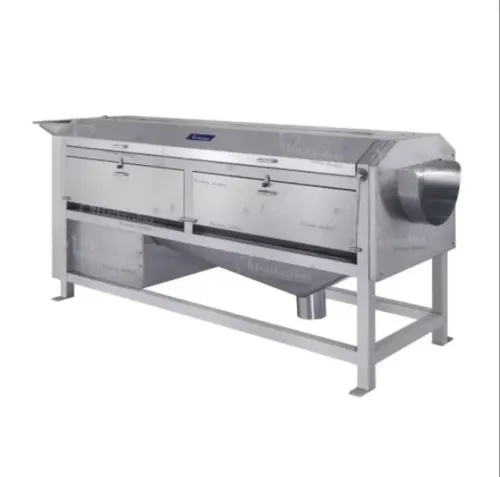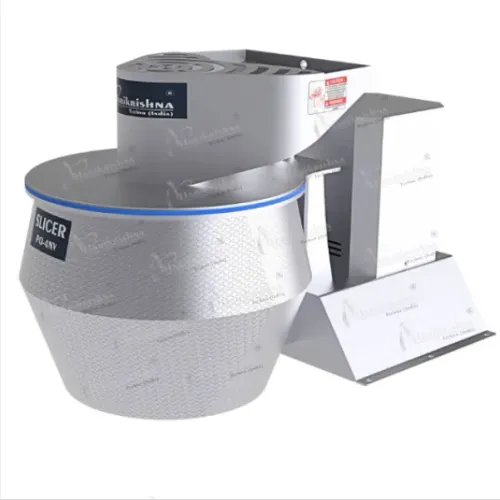
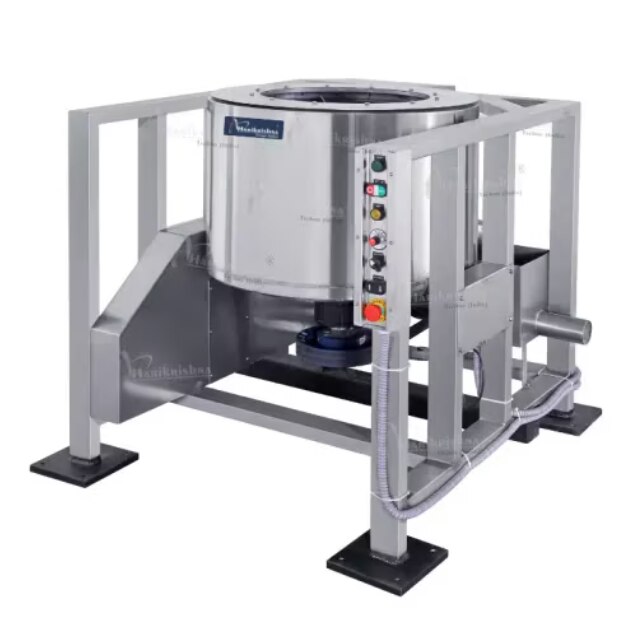
The DR-2 and DR-3 labels do not reveal which dryer will produce more saleable chips, because they are supplier model names rather than international capacity classifications. Compare both machines on washed-slice throughput, outlet surface moisture, slice damage, energy use and fryer performance before choosing a model for your line.
Key takeaways
- Install the dryer after slicing or blanching and before frying.
- Compare DR-2 and DR-3 using slices per hour, not model names alone.
- Check surface moisture after dewatering before increasing fryer heat.
- Match dryer output to fryer feed rate to prevent bottlenecks.
Where the Dryer Fits Before the Fryer
The dryer belongs after washing, slicing and any blanching step, but before the fryer. Its immediate job is to remove free water clinging to slice surfaces, because that water increases oil splashing, slows frying and worsens colour control.
- Wash and peel the potatoes, then slice them to the specified thickness.
- Rinse or blanch the slices, if the recipe requires it.
- Feed the wet slices into the dewatering stage, such as a centrifugal unit, air knife or hot-air dryer.
- Transfer the surface-dewatered slices directly to the fryer.
A DR 2 dryer at this point is not meant to dry the potato through to the low moisture of a finished chip. The slice still contains substantial internal moisture; frying removes that moisture while creating the chip’s texture.
Surface dewatering and potato drying are different jobs. Centrifugal force or an air knife removes loose water with little thermal load and short residence time. Hot air offers more controlled moisture removal, but demands heater capacity, exhaust handling and longer residence time.
Excessive heat or airflow can dry the edges before the centre, producing curled or brittle slices and changing frying colour.
When choosing a potato processing dryer in Rajkot, judge the result by surface moisture, product temperature, slice thickness, air velocity and residence time—not air temperature alone. A DR 2 dryer should reduce water entering the fryer, not turn the pre-fried slice into a partially cooked, uneven product.
Compare DR-2 and DR-3 on a Common Production Basis
Treat DR-2 and DR-3 as supplier model names, not standard capacity classes. A reliable potato chips dryer comparison starts with identical wet-slice input: kilograms of washed or blanched slices entering the machine per hour, not finished-chip output.
| Basis | DR-2 | DR-3 |
|---|---|---|
| Wet-slice throughput | State kg/h at tested load | State kg/h at tested load |
| Batch operation | State kg/batch and batches/hour | State kg/batch and batches/hour |
| Drum or chamber | State dimensions and usable volume | State dimensions and usable volume |
| Operating conditions | State speed, cycle time and product temperature | State speed, cycle time and product temperature |
| Moisture result | State outlet surface moisture and test method | State outlet surface moisture and test method |
| Power and space | State motor, heater, total kW and footprint | State motor, heater, total kW and footprint |
Ask for the figures under the same test conditions: potato variety, slice thickness, feed temperature, washing or blanching step, initial surface-water level, loading mass and target outlet moisture. For a continuous hot-air machine, also request air temperature at the product, air velocity, residence time, recirculation ratio, exhaust arrangement, humidity-control method and heater fuel.
Reject “dryer capacity” stated without these details. Frying removes water, while rejects and oil pickup alter mass, so finished-chip tonnes per hour cannot be converted directly into dryer throughput.
The correct choice in a DR 3 or DR 2 dryer for potato chips in Rajkot is the unit that demonstrates stable outlet moisture at your required wet-slice rate. A dr 3 dryer is not automatically superior to a dr 2 dryer; an oversized machine can waste energy and handle a lightly loaded bed poorly.
Set the Loading, Dewatering and Moisture Checks
Load the dryer at a fixed wet-slice rate, not by filling the drum to its physical limit. Keep slices evenly distributed around the basket; an off-centre load makes a centrifugal unit vibrate, damages slices and produces inconsistent dewatering.
Run the acceptance test with your potato variety, slice thickness, wash or blanching recipe and intended feed rate. Record these controls before comparing a DR 3 dryer with a DR 2 dryer.
1. Confirm drum speed, basket diameter, permissible slice thickness, loading mass and cycle time. Repeat each run at the proposed production load, not during a no-load demonstration.
2. Weigh the sliced potatoes entering and leaving the machine. Measure outlet moisture using the same sampling method each time, and record product temperature at discharge; hot, brittle or curled slices indicate excessive residence time or drying intensity.
3. Count broken slices and fines from a defined sample, then compare the percentage with your pre-set limit. Excessive speed, overloading or prolonged tumbling can turn acceptable slices into fryer loss.
4. Run the dewatered slices through the fryer for a sustained production period. Check oil splashing, foaming, crust formation, colour, oil carryover and fryer recovery time.
Accept the dryer only when outlet moisture, temperature, breakage and fryer behaviour remain within your limits across repeated runs. Ask for inlet and outlet mass, cycle time, energy consumption and batch records; a single attractive sample proves little.
Choose Capacity Without Overbuying or Starving the Fryer
A DR-2 is the better operational choice when one shift, several products or frequent recipe changes leave long idle periods. It limits heated air, cleaning time and work-in-process inventory, while a DR-3 operated far below its design load can waste energy and handle slices less consistently.
Model labels are supplier designations, not standard capacity classes. Use this potato chips dryer comparison on measured wet-slice throughput, not finished-chip output.
| Option | Best fit | Main capacity decision |
|---|---|---|
| DR-2 | One shift or multiple products | Choose it when scheduled batches feed the fryer without long gaps and changeovers are frequent. |
| DR-3 | Continuous, high-rate production | Choose it when the fryer needs uninterrupted feed and the dryer retains reserve capacity for seasonal potato variation. |
| Either model | Uncertain demand | Run an acceptance test at your target feed rate before committing to the larger machine. |
Reserve capacity must cover the peak schedule, not an optimistic average. For a DR 3 or DR 2 dryer for potato chips in Rajkot, require the supplier to demonstrate your slice thickness, recipe and target kilograms per hour, then record energy use, outlet moisture and fryer behaviour during a sustained run.
Compare batch size, cycle time, wet-slice throughput and installed load. A larger dryer earns its place when it prevents fryer starvation; otherwise, split production into planned batches and avoid paying to heat unused capacity.
Check Rajkot Site, Hygiene and Supplier Support Before Ordering
Do not approve a potato processing dryer in Rajkot until the site survey records ambient temperature, humidity, electrical supply, drainage, washdown access and the route for moist exhaust air. Rajkot heat can reduce the margin of an air-cooled electrical panel or refrigeration-based moisture-control system, so require the supplier’s derating calculation for the actual site.
Check these points before signing:
- Confirm voltage, phase, frequency, short-circuit protection and installed load. Record compressed-air pressure, filtration and dew point when pneumatic controls are included.
- Provide extraction and make-up air for moist exhaust. Do not discharge humid air into the production room, where condensation can contaminate surfaces.
- Specify removable screens, guards and duct panels. Potato starch and fines blind perforations, restrict airflow and reduce capacity before the motor shows a fault.
- Require the permitted cleaning method, sanitation chemicals, drainability and drying procedure. Reject inaccessible ledges, unsealed hollow frames and trapped-water pockets.
- Include spare screens or belts and differential-pressure or airflow monitoring. These expose starch buildup before the DR 3 dryer or DR 2 dryer quietly loses throughput.
Ask HARIKRISHNA TECHNO (INDIA) for a signed performance sheet, not only a model name. It should state usable batch capacity or sliced-potato throughput, moisture-removal duty, air temperature and velocity, residence or cycle time, installed power, exhaust volume, noise, and test moisture readings. Request the same test conditions for both models so “capacity” is reproducible.
Related products
 | DRYER DR-3 centrifuge dryer is a machine that uses centrifugal force to remove excess liquid, such as water, oil. View product → |
 | DRYER DR-2 centrifuge dryer is a machine that uses centrifugal force to remove excess liquid, such as water, oil. View product → |
Frequently asked questions
Where does a potato chips dryer fit in the production line?
Place it after washing, slicing and any blanching step, but before the fryer. It removes free water from slice surfaces before frying.
How should you compare a DR-2 dryer with a DR-3 dryer?
Compare both models on a common basis: potato slice throughput, loading rate, dewatering performance, moisture checks, power use, floor space and compatibility with your fryer.
What should you check after drying potato slices?
Inspect the slices for free surface water and record moisture results at a consistent sampling point. Use the readings to adjust loading and dewatering before changing fryer settings.
How do you choose dryer capacity for a potato chips plant?
Match dryer output to the fryer's actual feed rate, allowing for slicing, blanching and cleaning interruptions. An oversized dryer raises cost, while an undersized dryer starves the fryer.
Related products
 | AUTOMATIC POTATO CHIPS PLANT At Harikrishna Techno India, we understand that a perfect potato chip is a blend of quality ingredients and precision engineering. View product → |
 | SLICER Model Po-3NV cutting machine is a crucial piece of equipment in the production of potato chips, designed to efficiently and consistently sliced... View product → |
 | SLICER Model Po-3CL cutting machine is a crucial piece of equipment in the production of potato chips, designed to efficiently and consistently sliced... View product → |
 | SLICER Unlock Unprecedented Production with Our High-Capacity Slicer Machines At Harikrishna Techno India, we don't just build machines; we engineer... View product → |
Keywords