Produce enters a bubble washer with soil, plant debris and uneven sizes, so cleaning performance depends on more than bubbles in a tank. You will be able to follow the working sequence, match settings to different commodities, separate washing from sanitising, and compare a commercial machine by its measurable process results.
Key takeaways
- Use immersion, air turbulence and a rinse to remove loose soil and debris.
- Reduce turbulence for leaves; use stronger agitation for roots and firm fruit.
- Treat washing and sanitising as separate steps with separate controls.
- Compare tank design, air adjustment, rinse flow and discharge handling before buying.
What happens to produce inside a bubble washer?
A bubble washer cleans produce by combining immersion, buoyancy and air-induced turbulence, then carrying it through a controlled rinse and discharge. The bubble washer working process runs in this order:
1. Pre-sort the load. Remove stones, soil clods and badly damaged pieces before they enter the machine; they can block screens, damage conveyors or spread contamination.
2. Feed produce into the inlet without overfilling it. Excess product forms a raft, blocks leafy vegetables and prevents water and air from reaching dirty surfaces.
3. Fill the tank to its specified operating level. The correct level keeps produce immersed without allowing it to spill over the tank or overload the lift-out point.
4. Start the blower and introduce air through the air pipe, diffuser or perforated manifold. Rising bubbles lift and separate pieces while turbulence loosens soil, sand and plant debris from the surface.
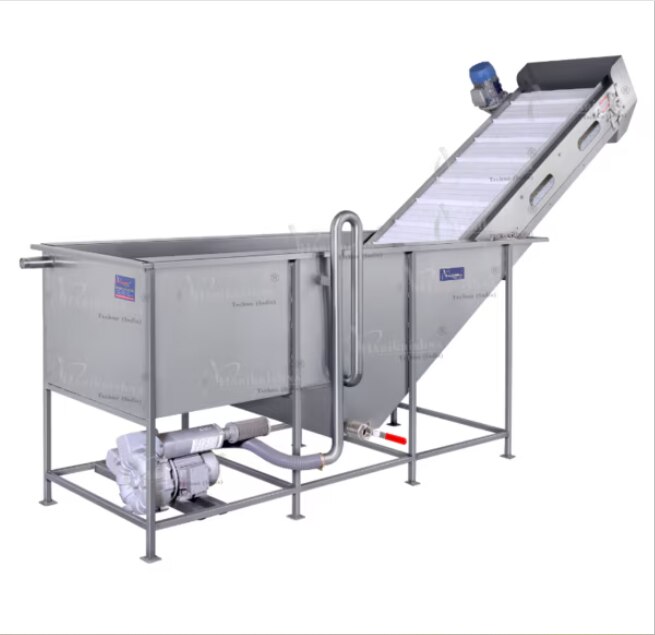
5. Move the produce through the tank on a perforated belt, paddle conveyor or elevator. Its speed sets residence time as much as the blower does: excessive speed gives poor cleaning, while slow movement can create stagnant accumulation zones.
6. Adjust immersion depth, conveyor speed and air volume together. Keep the product submerged for the required contact time without bruising delicate produce or matting leaves.
7. Lift the cleaned produce out, apply a final clean-water spray or rinse, and let water drain through the belt or discharge section. Unload only after free water has run off and remove collected solids from the drain and screens.
How air, water and product preparation determine cleaning quality
Useful turbulence comes from matching air energy to the produce, not from maximum blower output. In a fruit vegetable bubble washer, the blower pushes air through an air pipe into diffuser holes or a perforated manifold. Hole spacing, manifold layout and diffuser position distribute bubbles across the tank; uneven coverage leaves quiet, dirty pockets.
1. Prepare the load before washing. Remove stones, trim severely damaged portions, separate oversized items and stop leafy vegetables from blocking the inlet or outlet. Overloading creates a mat that traps soil against leaves.
2. Set air-flow control to the lowest output that turns the load over and exposes its surfaces. More air can bruise soft fruit, split stems, strip skins or force leaves into tight layers where dirty surfaces remain shielded.
3. Check immersion depth and diffuser position together. Greater water depth increases the pressure the blower must overcome and can reduce bubble flow at the bottom; shallow immersion gives weak contact. Move or balance diffusers so bubbles reach the product rather than escaping beside it.
4. Match conveyor speed to the air pattern. A perforated belt, paddle conveyor or elevator needs enough residence time for soil release without allowing accumulation in stagnant zones.
A single tank is simpler, but its water becomes soil-loaded. Separate wash and rinse zones are cleaner: use overflow or make-up water to displace dirty water, then supply a dedicated clean-water spray at discharge. Without that flow, the rinse stage merely spreads loosened soil and residual process water over the product.
How to set the machine for leaves, roots, fruit and cut produce
Leafy greens need full submergence, roots need stronger turbulence, delicate fruit needs gentler handling, and cut produce needs the tightest water-control plan. The same Rajkot bubble-washer setting will not clean every commodity equally.
| Commodity | Water level and air output | Agitation time and conveyor speed |
|---|---|---|
| Leafy greens | Keep leaves fully submerged; use moderate blower output and anti-bunching control | Allow enough residence time for soil release; slow the conveyor if leaves ride in clumps |
| Carrots and potatoes | Use a high enough water level for immersion, stronger turbulence and solids screens to remove loosened soil | Increase residence time or reduce belt speed when incoming soil is heavy |
| Tomatoes and delicate whole fruit | Use lower air pressure and mechanical energy | Use gentle transfer points, short handling distances and faster passage |
| Cut produce | Keep exposure controlled and use clean, monitored water to limit cross-contamination | Use the shortest validated residence time and avoid unnecessary recirculation |
Floating leaves that bunch together shield dirty surfaces, so adjust the inlet, anti-bunching device and conveyor loading before increasing blower output. Excessive agitation bruises tomatoes, splits stems and damages cut surfaces.
For cut produce, monitor water replacement, overflow, screens, drains and sanitizer controls because contaminated recirculated water can spread organisms between lots. Validate the actual water quality and exposure time.
Test the buyer’s commodity, size range and incoming soil load; tank dimensions and nominal capacity do not prove performance. Record:
- Throughput in kg/h
- Water use
- Residence time
- Visible soil removal
- Product loss
- Bruising
- Condition at discharge
When bubble washing is not the same as sanitising
Bubble action removes loose soil, sand and surface plant debris; it does not reliably remove deeply embedded soil, wax, bruising, microbial contamination or pesticide residues. Washing is physical cleaning, not microbial reduction.
1. Define a separate sanitising control when the product, risk assessment or customer specification requires it. For chlorine-based water, establish 50–200 mg/L free chlorine, pH 6.5–7.5, 1–2 minutes’ contact time, and produce-compatible water temperature through validation. Where used, target an ORP of about 650–750 mV.
Check free chlorine with a DPD colorimeter or test kit, pH with a calibrated meter, ORP with a calibrated probe, temperature with a thermometer and contact time with a timer. Follow the sanitizer label and validate the actual commodity; concentration alone proves little because soil and plant sap consume sanitizer demand.
2. Keep wash water within 10°F, or 5.6°C, of the whole produce temperature. Colder water can draw contaminated water through cuts and stem scars as internal product pressure changes, unless you validate a control.
3. Replace water on a defined schedule, add make-up water or overflow, and use solids screens to remove soil. Provide accessible drains, clean the tank and remove sludge between lots or shifts according to contamination risk.
4. Send wastewater through the plant’s approved handling route. Confirm discharge, treatment and disposal arrangements with the applicable local authority in Rajkot or elsewhere in Gujarat; do not assume dirty process water can enter a drain untreated.
How to compare a commercial bubble washer in Rajkot
A commercial bubble washer in Rajkot can mean three different process boundaries, so compare what enters and leaves the machine, not the label on the quotation.
| Option | What it includes | What to confirm |
|---|---|---|
| Basic immersion-and-bubble unit | Wash tank and air agitation | Who loads, transfers, rinses and unloads the produce |
| Washer with elevator and spray rinse | Tank, conveyor lift and final rinse | Belt speed, rinse-water flow and discharge height |
| Complete pre-processing module | Washing linked to rinsing or downstream equipment | Included conveyors, controls, utilities and hand-off points |
Use this specification checklist:
- Commodity, size range, incoming soil condition and target throughput in kg/h
- Tank volume, immersion depth, rinse arrangement and water-reuse plan
- Sanitizer provision, dosing point and monitoring method, if required
- Belt speed, residence time, blower capacity or air-flow range
- Electrical supply, connected load, controls and drain connections
- Product-contact construction material, cleanable welded joints and fully drainable pipework
- Sloped tank bottom, removable screens and protection against dead pockets
- Cleaning method, including access for sludge removal and sanitation
Ask the supplier to run your own produce at its actual size and soil load. Record throughput, water use, residence time, visible soil removal, product loss or bruising and condition at discharge. A motor rating or polished exterior proves none of these.
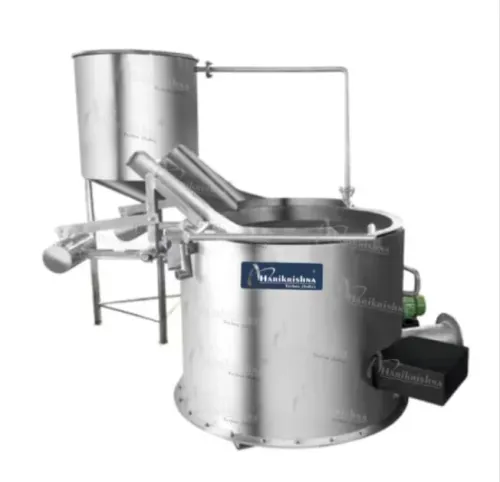
Harikrishna Techno (India), a Rajkot-based manufacturer and exporter, is worth consulting when the requirement extends from a washer to connected food-processing machinery; keep the comparison tied to documented results and included utilities.
Related product
 | BUBBLE WASHER HKT Bubble Washer used for cleaning fruits and vegetables. It utilizes the principle of air bubbles generated in a water tank to create turbulence... View product → |
Frequently asked questions
How does a bubble washer clean produce?
It immerses produce in water, uses air bubbles to create turbulence and buoyancy, then moves the produce through rinsing and discharge.
Can one bubble washer setting clean every type of produce?
No. Leaves, roots, fruit and cut produce need different handling because their buoyancy, firmness, surface area and damage risk differ.
Does bubble washing sanitise fruit and vegetables?
No. Bubble washing removes soil and debris; sanitising requires a controlled sanitiser, concentration, contact time, water quality and monitoring.
What should you compare when choosing a commercial bubble washer in Rajkot?
Compare tank capacity, air-intensity control, water circulation, rinse arrangement, discharge design, cleaning access and compatibility with your produce line.
Keywords