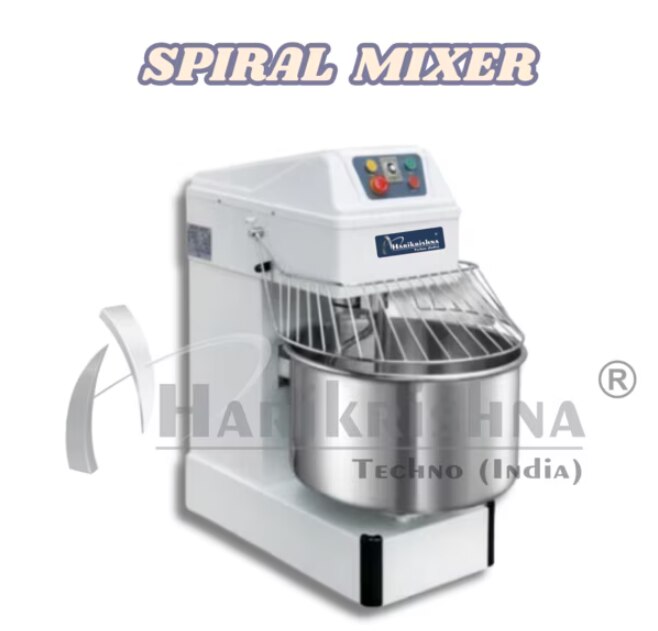
A spiral mixer does more than combine flour and water: its hook stretches the dough while the bowl presents fresh material for folding, developing structure and adding mechanical heat. By following the mixing stages, temperature signals, load limits and downstream hand-off, you can specify a machine and recipe that suit your snack line rather than choosing by bowl size alone.
Key takeaways
- Load ingredients in stages and monitor dough condition, not time alone.
- Use water temperature and mixing speed to control final dough temperature.
- Size the mixer by minimum and maximum dough batch, not bowl volume alone.
- Specify discharge height, power, controls and sanitation access for your Rajkot line.
What happens during a spiral mixer working process
The practical answer to how does a spiral mixer work in Rajkot is a controlled sequence, not a timer alone. The operator loads the bowl, develops the dough in stages, checks its condition and then discharges it without damaging its structure.
1. Add most or all of the liquid to the bowl, followed by flour and dry ingredients. Add salt, yeast, fat, spices, besan or inclusions at the formulation-defined point so they disperse without restricting hydration or being crushed.
2. Run the first stage slowly. This wets the flour and distributes the ingredients while limiting heat. If the bowl is driven, it continually presents fresh dough to the helical hook; the hook stretches, folds and compresses the mass.
Confirm the arrangement first: some spiral mixers have a rotating bowl, while others use a fixed bowl or another drive system.
3. Increase speed for the development stage. The hook builds gluten structure and homogenises the dough, but a bread-style programme does not suit every snack. High-fat, short or brittle dough can become hot, tight or smeared when overmixed.
4. Stop only when no dry flour pockets remain, hydration is even, the surface is consistent, elasticity matches the recipe and the dough temperature sits within its validated range. Record the temperature with a probe.
5. Lower the speed or stop under controlled conditions, open the guard only after movement ceases and discharge the dough into the next process. Mixing is complete when the dough transfers cleanly, not when the timer stops.
How the hook and bowl change the dough structure
A spiral mixer changes dough through two coordinated movements: the bowl turns continuously, feeding fresh dough to the hook, while the helical hook lifts, tears, stretches and folds the mass. It develops structure rather than merely beating the ingredients, giving strong dough a more controlled and elastic network.
The spiral mixer working process must separate blending from gluten development. Use slow speed to wet flour and distribute ingredients, then apply faster speed only for the required development. A bread-style programme can overwork crackers, fried snack doughs and short, high-fat formulations, making them tight, warm or smeared.
| Method | Physical action | Best fit and consequence |
|---|---|---|
| Spiral mixer | Rotating bowl presents dough to a lifting, stretching hook | Controlled development for structured doughs |
| Planetary mixer | Agitator travels around a generally stationary bowl | Broader range of batters, creams and lighter doughs |
| Horizontal mixer | Paddles or blades move dough across a trough | Large, continuous mass movement |
| Hand kneading | Hands press, fold and feel the dough directly | Tactile control, but variable energy, labour and batch uniformity |
Stop development when hydration is even, flour pockets have disappeared and the dough reaches the recipe’s required elasticity and surface. Do not chase maximum strength: crackers and short doughs need cohesion without a strong gluten network, while fermented or pizza-style doughs need validated development and temperature limits.
How to charge ingredients and control dough temperature
Charge the bowl by recipe, not by a fixed machine rule. Start with most or all of the liquid, add flour and other dry ingredients, then place salt, yeast, oil, besan, spices and inclusions at the point that gives the required dispersion and dough development.
1. Load water or other liquid first, then flour and dry powders. Check that no dry flour pockets remain during slow-speed incorporation.
2. Add salt and yeast according to the fermentation formula. Salt added early controls yeast activity and disperses evenly; delaying it changes fermentation behaviour and can leave salty areas. Treat delayed salt or yeast as a recipe decision, not a spiral-mixer requirement.
3. Add oil after the flour has hydrated when the formula needs full water absorption. Oil added too early can coat flour particles and limit hydration. Add besan and spices where trials show the best dispersion.
4. Add nuts, seeds, vegetables or other particulates late enough to prevent crushing and uneven distribution. Stop the slow stage when the mass is uniformly wet, then use the faster stage for the required dough development and homogenisation.
5. Stop on process evidence: a smooth surface, uniform hydration, elasticity, adequate strength and no flour pockets. Short, high-fat fried dough may need blending rather than extended gluten development.
6. Probe and record flour temperature, water temperature, mixing time and finished-dough temperature. Mechanical friction raises heat during high-speed or heavily loaded runs, affecting fermented, fried, filled and extruded products. Calculate water temperature from target dough temperature, batch size, mixer speed and flour temperature; never select it independently.
How to size a spiral mixer for the dough you actually make
Size the mixer from flour weight and dough yield, not nominal bowl volume. Calculate dough weight as flour weight × recipe dough-yield factor: 100 kg of flour at a 1.60 yield produces 160 kg of dough. Then confirm that the batch falls between the manufacturer’s minimum and maximum flour loads for that specific dough type.
A bowl below its effective minimum can leave the hook unable to capture ingredients, causing flour pockets and uneven hydration. An overloaded batch can climb the hook, draw excessive current, heat the gearbox and mix unevenly.
| Dough type | Sizing concern | What to verify |
|---|---|---|
| Stiff, low-hydration dough | Highest torque at equal volume | Low-speed torque, motor current and gearbox temperature |
| High-hydration dough | More volume and possible sticking | Dough weight, bowl clearance and extraction time |
| Besan-based mixture | Different cohesion and load behaviour | Minimum flour-equivalent load and final consistency |
| Laminated dough | Excess work can warm or tighten the dough | Gentle development, dough temperature and batch recovery |
| Oil, spices or inclusions | Oil can limit hydration; particles add drag | Addition sequence, dispersion and motor load |
Ask for a loaded site trial using representative recipes. Record motor current, dough temperature, mixing time, final consistency and extraction time.
When evaluating a variable-frequency drive, check its low-speed torque, motor rating, gearbox, cooling arrangement and overload protection. Adjustable rpm alone does not prove dough-handling capacity. A spiral dough mixer for food manufacturers is a recipe-and-load decision, not a bowl-volume purchase.
How the mixer fits a Rajkot snack line and plant specification
A mixer becomes a bottleneck when dough removal takes longer than the fryer or oven’s consumption rate. Match its discharge height and bowl access to the dough feeder, resting area, divider, sheeter, extruder or depositor, then calculate extraction time and batch interval so each downstream machine receives dough without starvation.
1. Map the complete route: dough feeding, resting, dividing, sheeting, cutting, forming, frying or baking, and cleaning. Measure the receiving machine’s inlet height and confirm that operators can extract the full batch without lifting hazards or delays.
2. For a commercial spiral mixer in Rajkot, verify the available three-phase 415 V, 50 Hz supply, phase balance, earthing, short-circuit protection, motor-starting method and VFD compatibility. During supervised commissioning, test the guard interlock and emergency stop with a loaded machine.
3. Put food-zone requirements in writing: 304 stainless steel where specified, smooth welds, shaft-seal design, crevice-free bowl access and compatibility with your cleaning chemicals. Do not hose the mixer unless its enclosure, bearings, seals and stated ingress-protection rating support washdown; one protected electrical component does not make the whole machine washable.
4. Evaluate HARIKRISHNA TECHNO (INDIA) by requesting recipe trials, minimum and maximum flour loads, discharge dimensions, electrical drawings, sanitation instructions and spare-parts support. For export lines, verify destination voltage, guarding and conformity paperwork.
Accept the machine only after dough quality, extraction and the downstream hand-off perform together at the required batch interval.
Related product
 | FLOUR KNEADING MACHINE Spiral Mixer The Spiral Mixer is an essential machine for dough preparation, designed for efficiency and durability. View product → |
Frequently asked questions
What happens during a spiral mixer working process?
The operator loads the bowl, mixes ingredients into a mass, develops gluten with the hook, checks dough temperature and condition, then discharges the finished dough.
How do the hook and bowl change dough structure?
The rotating bowl carries dough into the spiral hook, while the hook stretches, folds and compresses it. This develops strength and uniformity without relying on mixing time alone.
How should you charge ingredients and control dough temperature?
Add ingredients in a planned sequence, measure water temperature, select an appropriate speed and check the dough temperature before discharge. Record the batch result for repeatability.
How do you size a spiral mixer for the dough you actually make?
Compare your smallest and largest dough batches with the mixer’s minimum and maximum working capacities. Allow for dough density and absorption instead of sizing from bowl volume alone.
How does a spiral mixer fit a Rajkot snack line and plant specification?
Match the mixer to line throughput, discharge height, electrical supply, floor space, cleaning access, controls and the next process step, such as sheeting, extrusion, frying or drying.
Keywords