The right dryer depends on whether you need to remove free surface water and oil or evaporate moisture from inside the food. By comparing product requirements, capacity, utilities, hygiene, testing and utilisation, you can decide whether a centrifuge, hot-air, belt or vacuum dryer fits your Rajkot operation.
Key takeaways
- Use a centrifuge dryer for surface water or oil, not internal moisture removal.
- Compare drying temperature, airflow, capacity and cleaning access with your product target.
- Size the dryer from batch weight, moisture load, cycle time and available electrical supply.
- Run a paid production trial before approving the machine purchase.
What kind of drying does your product actually need?
A centrifuge dryer is suitable when your product carries free water or oil on its surface, not when its internal moisture must evaporate. It can drain washed vegetables, sliced potatoes, banana chips, cassava and fried snacks, but it will not produce a low-moisture dried food by itself.
| Option | What it does | When it applies |
|---|---|---|
| Centrifuge dryer | Spins off surface water or oil | Draining, dewatering and reducing surface oil |
| Hydro dryer | Removes surface water through high-speed air or mechanical action | Washed vegetables and similar wet products |
| Hot-air tray or cabinet dryer | Evaporates internal moisture in batches | Dehydrated foods and varied small production runs |
| Belt dryer | Evaporates moisture during continuous conveying | Regular, higher-volume production |
| Vacuum dryer | Lowers boiling temperature under reduced pressure | Heat-sensitive products needing gentler drying |
This comparison determines commercial food dryer suitability: choose centrifugal drying for free surface liquid, but not for foods requiring low final moisture, validated water activity or gentle handling of fragile pieces. Spinning can bruise delicate pieces or break brittle snacks.
For a dryer for snack production, treat centrifugal drying as pre-drying or dewatering only. It may improve handling and consistency, but it does not replace a fryer, oil filtration system or frying-temperature control. Use a complete drying process when the product needs evaporation, rather than expecting a centrifuge to create shelf stability.
How do Rajkot’s climate and your quality target affect the choice?
A dryer earns its place when open-sun drying cannot deliver the same endpoint from batch to batch. In Rajkot’s monsoon, rain, dust, insects and fluctuating humidity interrupt exposed drying; during the rest of the year, controlled air conditions give you a defined process instead of weather-dependent timing.
| Option | Process control | Main risk |
|---|---|---|
| Open-sun drying | Low; weather sets drying rate | Unrepeatable moisture and contamination |
| Controlled dryer | Set air temperature, airflow and exhaust | Higher purchase and operating cost |
Specify the final moisture content and water activity before comparing machines. Water activity measures available water, not simply total moisture; below 0.60 is a common preservation target for many low-moisture foods, but your product, packaging and intended shelf life determine the correct endpoint. Do not choose from tray capacity alone.
Two equal-weight loads can finish at different times. Slice thickness, salt or sugar content, pretreatment and product loading change the water-removal rate. Increasing heat is not a reliable shortcut: excessive temperature causes case hardening, browning, shrinkage, flavour loss and uneven rehydration.
For a food processing dryer in rajkot, require representative product-test data showing:
- Inlet and outlet air temperature
- Exhaust condition
- Drying time and final moisture or water activity
- Colour change and yield
- Energy used per batch or kilogram
A no-load demonstration cannot prove commercial performance.
How should you size the machine for a small production target?
Start with the kilograms you must produce, not the machine’s advertised batch size. Calculate daily demand from batch size, usable working load, cycle duration, loading and unloading time, loading frequency, and the required kilograms per day or per hour. A long changeover can eliminate the capacity advantage of a larger dryer.
For an evaporative dryer, compare water removed rather than raw feed weight. Estimate water removed from initial feed mass multiplied by the difference between initial and final moisture fractions, then reconcile that figure with final product mass: 100 kg at 70% moisture, dried to 10%, becomes about 33.3 kg, with 66.7 kg of water removed.
A quotation listing only raw kilograms per batch is not a meaningful comparison.
Ask for these figures:
- For a centrifuge dryer: basket volume, working load, rotational speed, motor power, dimensions, electrical supply, cycle duration, and throughput for your actual product.
- For an industrial drying machine in Rajkot: usable tray area, kilograms per square metre, air-temperature range, air velocity or circulation rate, exhaust control, and tested drying time.
A dryer for small food processing business in Rajkot must fit both output and available space.
| Option | Strength | Trade-off |
|---|---|---|
| Modular batch cabinet | Saves floor space and handles varied products | Requires loading and unloading between batches |
| Belt dryer | Provides continuous output | Needs higher utilisation and more floor space |
Choose the cabinet when demand varies; choose the belt system only when steady throughput will keep it occupied.
What must you verify before buying and installing the dryer?
A quoted machine is suitable only when its utilities, cleanability and room layout are confirmed on site. Ask the supplier to identify the heating option and its consequences:
| Heating option | What you must verify | Main installation consequence |
|---|---|---|
| Electric | Rated kW and phase requirement | Sanctioned electrical load, earthing and protection devices |
| LPG or thermal fluid | Burner controls, leak protection and combustion requirements | Ventilation, exhaust ducting and safe fuel handling |
| Steam | Steam pressure, consumption and condensate return | Boiler capacity, steam line and condensate arrangement |
| Hot water | Heating capacity and circulation requirements | Hot-water source, pump, insulation and drainage |
Require controllable fresh-air and exhaust dampers. Excessive recirculation retains moisture and slows final drying, especially with vegetables, fruit and cooked snacks.
Food-contact parts must use corrosion-resistant stainless steel with smooth welds, removable trays or racks, accessible corners and a chamber that opens for washing and sanitising. Apply FSSAI controls to raw materials, personnel hygiene, pest exclusion, cleaning, storage and cross-contamination; drying does not correct a dirty upstream process.
Before accepting a quotation from HARIKRISHNA TECHNO (INDIA), confirm these site items:
- Three-phase supply if required, earthing and protection devices
- Exhaust ducting, room ventilation and drainage
- Wash-down access and wastewater disposal
- Trolley movement, loading space and unloading clearance
These checks determine whether a food processing dryer in rajkot will work safely in your premises rather than remain a workable catalogue specification.
Related products
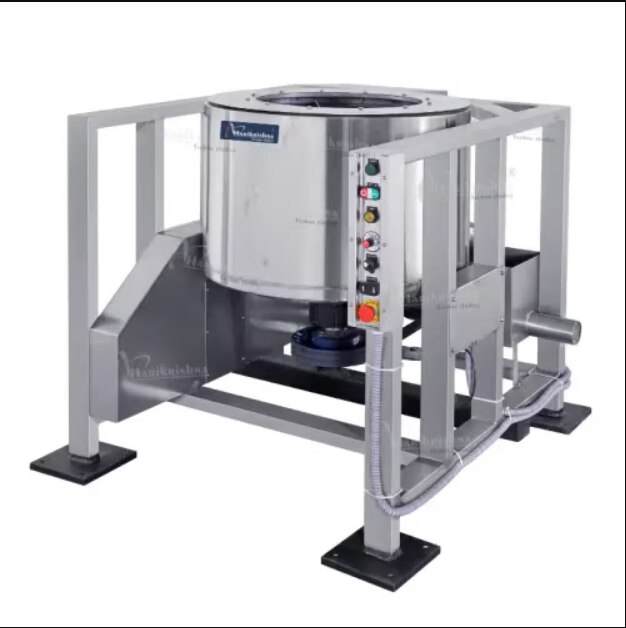
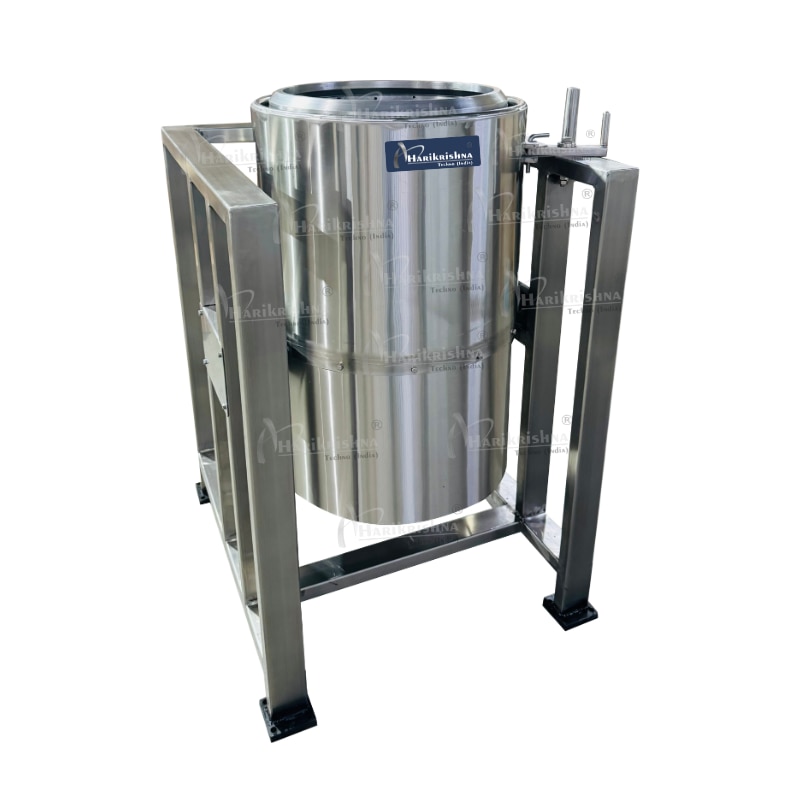 | DRYER DR-3 centrifuge dryer is a machine that uses centrifugal force to remove excess liquid, such as water, oil. View product → |
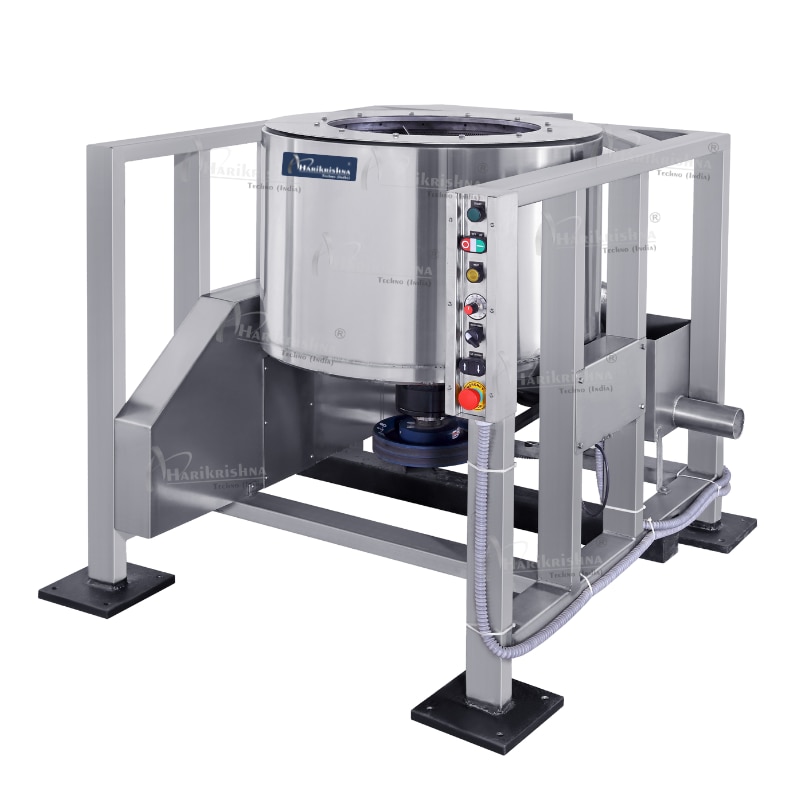 | DRYER DR-2 centrifuge dryer is a machine that uses centrifugal force to remove excess liquid, such as water, oil. View product → |
How can you prove performance and financial suitability before committing?
A representative product trial proves commercial food dryer suitability better than a catalogue capacity. Use the real recipe, slice thickness, pretreatment and loading pattern; reject a no-load demonstration or a trial using a different food.
| Option | Compare when | Main financial question |
|---|---|---|
| High-throughput machine | Regular, near-daily production | Will utilisation spread capital cost across enough kilograms? |
| Modular cabinet | Small or varied batches | Does lower capacity reduce cost per kilogram? |
| Contract or shared seasonal drying | Only a few batches monthly | Is outsourcing cheaper than ownership? |
For moisture removal, weigh a measured sample before and after drying. Record drying time, then compare the result with a moisture test and, where shelf stability matters, water-activity measurement.
For fried products, weigh the product before and after draining for a fixed time and at a fixed temperature. Do not promise an oil-reduction percentage without product-specific data. Record colour, breakage, shrinkage, yield, energy consumption and cleaning time.
Calculate cost per kilogram using:
- Purchase and installation cost
- Labour, electricity or fuel, and maintenance
- Rejected product and avoidable spoilage
A dryer for small food processing business in Rajkot is financially stronger when it runs regularly or prevents measurable quality losses. If it will run only a few batches each month, compare a smaller modular cabinet, contract drying and shared seasonal capacity before selecting a high-throughput machine.
Keep the trial record, test reports and utility readings with the quotation; they provide a defensible basis for the decision.
Frequently asked questions
What kind of drying does a small food business actually need?
Use a centrifuge dryer when the product carries free surface water or oil. Choose a hot-air or other evaporation dryer when internal moisture must be removed to reach a low final moisture level.
How do Rajkot’s climate and quality targets affect dryer selection?
Specify the required final moisture, product temperature, drying time and acceptable colour or texture. Rajkot’s heat and humidity affect cooling, storage and air-handling requirements, so test the machine under production conditions.
How should you size a dryer for a small production target?
Calculate batch weight, moisture or surface-liquid load, target cycle time and operating hours. Compare those figures with the machine’s usable load, not only its advertised chamber volume.
What should you verify before buying and installing a food dryer?
Check food-contact materials, temperature and airflow controls, cleaning access, drain design, electrical load, ventilation, floor space, spare parts and installation requirements.
How can you prove a dryer is financially suitable before committing?
Run a production trial using your product and record throughput, cycle time, energy use, yield, final moisture, quality defects, labour and cleaning time. Approve the purchase only when the trial supports your target cost per kilogram.
Keywords