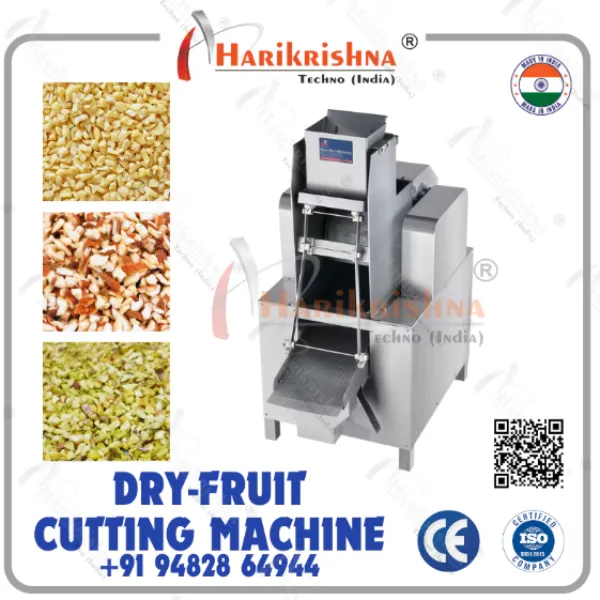
Dry fruits are used across sweets, bakery products, snack mixes, confectionery, catering and packaged foods. When these ingredients are required in significant quantities, manual cutting can become a time-consuming production stage.
A Dry Fruit Cutting Machine can support businesses seeking a more organised method of preparing suitable dry fruits for commercial applications.
Know Your Required Finished Product
The first question should not be about machine price. It should be about the desired output.
Different businesses may need dry fruits prepared for:
- Sweet manufacturing
- Bakery toppings
- Namkeen products
- Confectionery
- Ingredient mixes
- Catering
- Packaged food production
Cut requirements can vary according to the final application, so these should be defined before equipment selection.
Production Volume Indicates Readiness
A commercial machine becomes particularly relevant when manual preparation starts restricting output.
Signs that a business may be ready to mechanise include increasing daily production, difficulty maintaining preparation speed, higher labour allocation to repetitive cutting and demand for more consistent finished dimensions.
Evaluate the Actual Dry Fruits
Dry fruits vary significantly in shape, hardness and texture. Buyers should therefore specify which products they intend to process.
Equipment suitability should be confirmed against actual processing requirements rather than assuming every type of dry fruit will behave identically.
Machinery Requirements for Rajkot Businesses
Rajkot is an important manufacturing centre in Gujarat, while the state's food sector includes numerous snack, bakery, sweets and packaged-food businesses.
Harikrishna Techno (India) supplies food-processing machinery for commercial production requirements. Buyers considering dry-fruit cutting equipment should communicate expected volume, product type and required output before choosing a configuration.
Check the Operational Details
Before placing an order, evaluate practical factors such as:
- Expected hourly capacity
- Product feeding
- Cutting requirements
- Food-contact construction
- Cleaning access
- Operator requirements
- Installation space
- Maintenance access
Also consider whether the machine will operate independently or become part of a larger ingredient-preparation line.
When Investment Makes Operational Sense
Mechanisation should solve a measurable problem. If manual cutting already handles the required volume comfortably, a larger machine may not be necessary.
If cutting is repeatedly delaying production, consuming significant labour or making expansion difficult, equipment investment becomes easier to justify.
Food manufacturers in Gujarat can discuss their dry-fruit processing requirements with Harikrishna Techno (India) to determine a machine configuration appropriate for their intended production volume and application.
Keywords